
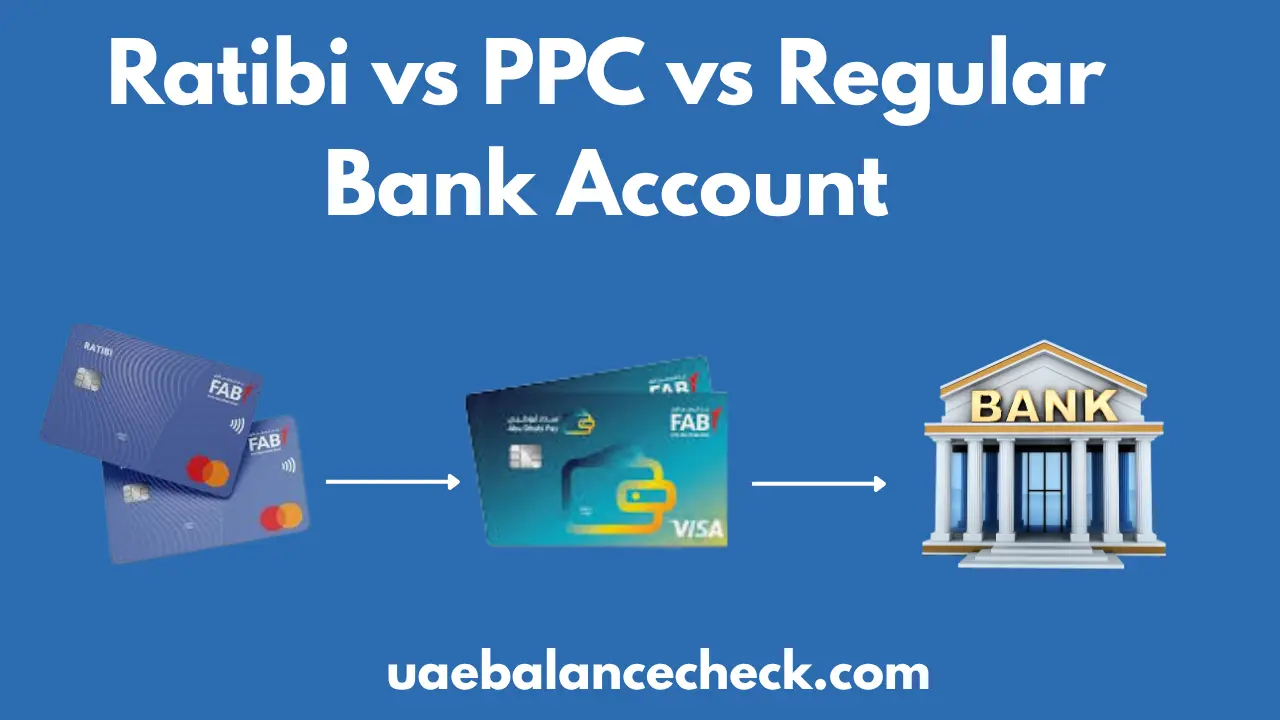
If you work in the UAE, your monthly salary lands somewhere, and that “somewhere” is one of three things: either a Ratibi card, a Payroll Prepaid Card (PPC), or a regular bank account. Many employees do not realise they have a choice, and the option their employer has them registered on is rarely the cheapest or most flexible for them.
This guide walks through the three salary-receipt options available in the UAE in 2026, what each one is, who they are designed for, and how to decide which one fits your situation.
Why You Have Three Options
The UAE Wages Protection System (WPS) requires every employer to pay salaries through approved channels. WPS-approved channels include licensed banks, exchange houses, and prepaid salary card programs. The result is a market with three product categories that all do the same job, receiving your monthly salary but with very different features, fees, and limitations.
The choice usually comes down to your salary level, your residency status, and what you plan to do with the money once it lands.
Option 1: Ratibi Card

Ratibi is a prepaid salary card issued by FAB. It is designed primarily for low-income workers who do not qualify for or do not need a full bank account.
Who Ratibi Is For
- Workers earning below the threshold for a full salary account
- Employees on temporary contracts
- Workers whose employers prefer prepaid card processing for administrative reasons
- Anyone who does not want a full banking relationship
Key Features
- No minimum salary requirement
- No monthly maintenance fee in most cases
- Salary credited directly via WPS
- Cash withdrawal at any FAB ATM at no charge (limits apply)
- Card-based shopping at all merchants accepting Visa or Mastercard
Limitations
- No cheque book
- No personal loan eligibility through this card alone
- Cash withdrawals at non-FAB ATMs carry a fee
- Limited to debit functionality no credit features
Balance Check Options
Cardholders can check their balance through the dedicated FAB prepaid portal, the FAB Mobile App, SMS, or any FAB ATM. The dedicated Ratibi balance check methods cover all available routes step by step.
Option 2: Payroll Prepaid Card (PPC)

PPC is similar in concept to Ratibi but operates as a more flexible product. Several UAE banks offer PPC variants. The card is designed to bridge the gap between a full bank account and a basic prepaid card.
Who PPC Is For
- Mid-tier workers whose employers run payroll through prepaid programs
- Employees whose income falls between Ratibi territory and full-account eligibility
- Workers who want some banking features (online portal, app access) without the documentation overhead of a full account
Key Features
- Online and mobile app access
- Direct salary credit via WPS
- ATM withdrawals at the issuing bank’s network at no charge
- Card-based payments are accepted globally
Limitations
- Maximum balance limits set by the bank
- Generally, no overdraft or credit facility
- Loading and reloading rules vary by issuer
- Some PPC variants charge a monthly card maintenance fee after the first few months
Option 3: Regular Bank Account

A regular salary account at a UAE bank is the most flexible option. It opens access to the full range of banking products, including credit cards, personal loans, mortgages, fixed deposits, investment services, and so on.
Who a Regular Bank Account Is For
- Employees earning above the bank’s minimum salary requirement (typically AED 5,000 to AED 10,000, depending on the bank and product)
- Anyone planning to apply for credit cards, personal loans, or a mortgage
- Long-term UAE residents who want a banking relationship that grows with them
- Employees whose employer is on the bank’s approved list
Key Features
- Full salary transfer with associated benefits (preferential loan rates, fee waivers, free debit cards, sometimes welcome bonuses)
- Cheque book and bank-issued payment instruments
- Eligibility for the bank’s full credit product suite
- Multiple linked accounts (savings, current, foreign currency)
- Online banking, mobile app, and full branch access
Limitations
- Minimum balance requirements when not receiving a salary transfer
- Documentation overhead at account opening
- Can take several days to set up
- Some banks charge fees if the salary transfer stops, even if the account stays open
Balance Check Options
Salary account holders can check balances through the bank’s mobile app, online banking, ATM, or SMS — all of which work the same way as for any non-salary account at the same bank.
Comparison Table
| Feature | Ratibi | PPC | Regular Bank Account |
|---|---|---|---|
| Minimum salary | None | Varies | AED 5,000+ typical |
| Account opening | Done by the employer | Done by employer | Done by the employee |
| Cheque book | No | No | Yes |
| Credit card eligibility | No (via this product) | Limited | Full |
| Loan eligibility | No (via this product) | No | Yes, with salary transfer |
| Maintenance fee | Typically none | Sometimes | Yes, if no salary transfer |
| Maximum balance | Capped | Capped | Unlimited |
| Mobile app access | Limited | Yes | Yes |
| Best for | Low-income workers | Mid-tier workers | AED 5,000+ earners with longer-term plans |
How to Decide
The decision usually maps to three questions.
Question 1: How Much Do You Earn?
If your monthly salary is below AED 5,000, your effective options are Ratibi or PPC. Most banks will not open a full salary account below this threshold, and even when they do, the account often comes with monthly fees that eat into a small salary.
If you earn AED 5,000 or more, you qualify for a full bank account. Whether this is the right choice depends on the next two questions.
Question 2: Do You Plan to Use Credit?
A prepaid salary card cannot, on its own, qualify you for a credit card or personal loan. If you plan to apply for either in the next year or two, you are better off receiving your salary into a regular bank account from the start. The bank uses your salary credit history when evaluating credit applications, and a longer history at the same bank helps your case.
If you have no intention of taking on credit, a Ratibi or PPC card is functionally fine and saves you the documentation hassle.
Question 3: How Long Do You Plan to Stay in the UAE?
For workers on short-term contracts, a prepaid card is often the simpler choice. There is nothing to close down when you leave, and the employer handles most of the setup.
For long-term residents, a banking relationship pays off over time. Preferential rates, account upgrades, and access to better card and loan products all accrue with time at the same bank.
A Note on Switching
If you are currently on Ratibi or PPC and want to move to a full bank account, the process involves opening the account first, then notifying your employer’s HR to update the WPS file. The change takes effect from the following salary cycle. Most employers handle the request without issue — it is a common request.
When choosing which bank to open the account with, the published features (minimum salary, fee structure, free benefits, partner offers) vary considerably between banks. Aggregator sites such as Masarif.ae compile this information across most UAE banks in one place, which can save time of visiting multiple bank websites or branches just to compare basic features.
Frequently Asked Questions
Can I have both a Ratibi card and a regular bank account?
Yes. The Ratibi card is registered with your employer for WPS purposes; the bank account is separate. However, your salary will only be credited to whichever one is registered in the WPS file at any given time.
Is Ratibi safer than a bank account?
Both are regulated. Ratibi balances are protected within the FAB system; bank account balances are protected under the same federal deposit framework that applies to all UAE banks.
Can my employer force me to use a Ratibi or PPC card?
Employers register employees on a salary product of their choice for administrative convenience, but employees can request a change to a regular bank account. Some employers may push back if their payroll system is designed around prepaid cards, but the UAE Labour Law does not allow forcing a specific salary-receipt method on an employee.
What happens to my Ratibi card if I change jobs?
The card itself remains active until the balance is depleted, but no new salary will be credited. You will need to register for a new salary product (Ratibi, PPC, or bank account) with your new employer for future salaries.
Conclusion
The three salary options in the UAE serve different segments of the workforce. Ratibi and PPC are simple, low-commitment products designed for workers who do not need full banking access. A regular bank account is the right choice for anyone earning above the minimum threshold who plans to use credit products, build a long-term banking relationship, or just wants more flexibility with their money.
The right choice depends less on which product is “best” in the abstract and more on which one matches your salary level, your credit plans, and your time horizon in the UAE. Most workers who earn enough to qualify for a regular bank account benefit from making the switch, even if their employer’s default is a prepaid card.
